Economy

The Polycrisis and Emerging-Market Resilience: Climate Shocks, Financial Volatility, and Geopolitical Fragmentation as Simultaneous Stressors – Building Adaptive Macroeconomic Frameworks for Compounding Risks

This report examines how climate shocks, financial volatility, sovereign debt pressures, and geopolitical fragmentation interact to create compounding macroeconomic risks for emerging and developing economies. It argues that these interconnected stressors can produce non-linear effects, including capital flight, currency depreciation, food and energy inflation, shrinking fiscal space, and sovereign debt distress, making conventional approaches designed […]

The Polycrisis and Emerging-Market Resilience: Climate Shocks, Financial Volatility, and Geopolitical Fragmentation as Simultaneous Stressors – Building Adaptive Macroeconomic Frameworks for Compounding Risks Read More »

Six Major Risks in Modern Society: Research Progress and Future Directions

The authors review six major systemic risks facing modern societies: geopolitical risks, global meteorological disaster risks, regional environmental risks, global supply chain risks, systemic financial risks, and technology-mediated societal and institutional risks. They show how these risks increasingly interact across political, economic, environmental, technological, and social systems, allowing disruptions in one domain to generate cascading

Six Major Risks in Modern Society: Research Progress and Future Directions Read More »

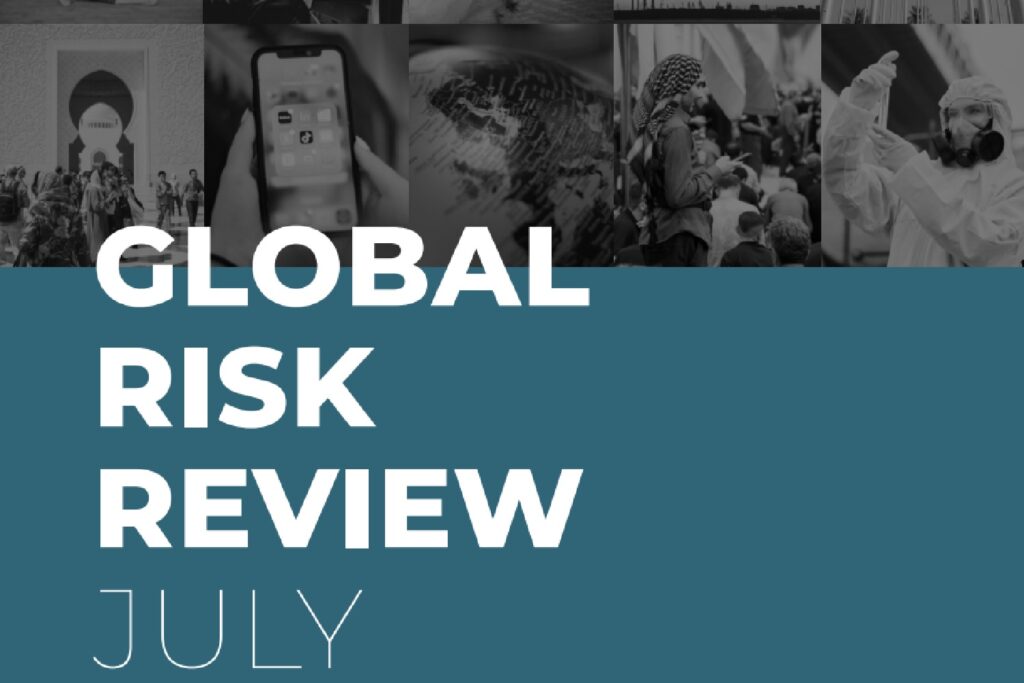
Global Risk Review

The July 2026 Global Risk Review identifies geopolitical escalation, climate extremes, digital misinformation, public health emergencies, and digital transformation as five key global risks. The report argues that these risks are increasingly reinforcing one another, creating a complex threat environment in which disruptions cascade across political, economic, social, and environmental systems. Through thematic analyses and

Global Risk Review Read More »

The Financial System is a Giant Polycrisis Waiting to Happen

The author argues that today’s financial system faces a polycrisis characterized by multiple vulnerabilities including highly leveraged Treasury basis trades, record sovereign debt levels, commercial real estate refinancing pressures, growing exposure within opaque non-bank financial institutions, dangerously concentrated AI-driven equity markets, and destabilizing geopolitical pressures from conflicts involving Iran and Russia. Unlike 2008, where stress

The Financial System is a Giant Polycrisis Waiting to Happen Read More »

Shock Absorbers or Amplifiers? How Do Firms Transmit Shocks in a Polycrisis Era?

The authors explore how global oil prices and geopolitical tensions are reshaping the spread of financial risk among firms worldwide. Analyzing over 1,300 publicly listed companies in 55 countries between 2016 and 2023, they find that slow-building, long-term shifts in oil prices and geopolitical instability do the most damage, embedding risk more deeply into corporate

Shock Absorbers or Amplifiers? How Do Firms Transmit Shocks in a Polycrisis Era? Read More »

Immigration, War, Economic Collapse: Will the Global Order Change in 2026?

This article presents Fair Observers’s 2026 geopolitical outlook using a Social, Political, Economic, Religious, and Military framework. The authors argue that overlapping global stresses, immigration pressures, democratic dysfunction, economic fragility, and strategic rivalry, are accelerating institutional erosion. The analysis outlines key global risk dynamics, including the rise of far-right movements in Europe, increasing state fragility,

Immigration, War, Economic Collapse: Will the Global Order Change in 2026? Read More »

‘History will tell’: as US pressure grows, Cuba edges closer to collapse amid mass exodus

The author examines Cuba’s ongoing polycrisis, characterized by the convergence of economic collapse, demographic decline, social fragmentation, and political repression. Mass emigration is accelerating population loss and weakening public institutions, while economic contraction across nearly all sectors has deepened inequality and eroded the foundations of Cuba’s once-renowned healthcare and education systems. Despite widespread disillusionment, internal

‘History will tell’: as US pressure grows, Cuba edges closer to collapse amid mass exodus Read More »

Top Risks 2026

The report presents Eurasia Group’s annual forecast of the political risks most likely to play out over the course of 2026. It outlines ten key global developments expected to shape the geopolitical landscape, including state-level conflicts, technological disruption, institutional challenges, and economic pressures. The analysis frames 2026 as a potential tipping point, marked by heightened

Top Risks 2026 Read More »

Mapping the Hope Attractor: A Conversation with Thomas- Homer Dixon

In this conversation, Thomas Homer-Dixon introduces the Cascade Institute’s Polycrisis Core Model (PCM), a novel framework designed to map and analyse interactions among 11 critical global systems, each with multiple potential future states. The model employs cross-impact balance (CIB) analysis to evaluate over four million internally consistent scenarios, ultimately identifying 11 distinct “attractor” states. These

Mapping the Hope Attractor: A Conversation with Thomas- Homer Dixon Read More »

Climate Change and Systemic Risk: Evidence from Financial Intermediaries

The authors investigate the impact of climate-induced temperature shocks on systemic risk within the banking sector. Using a sample of 35 financial intermediaries across 13 countries and employing the ΔCoVaR methodology, the authors find that deviations from historical temperature averages are associated with heightened systemic risk, concluding that climate volatility threatens financial stability by amplifying

Climate Change and Systemic Risk: Evidence from Financial Intermediaries Read More »

Scroll to Top