None

Check here if the Systems Addressed is not identified

Further Explication of the Mega-Crisis Concept and Feasible Responses

The article analyzes the concept of mega-crisis in comparison with crisis. It defines the mega-crisis as a “set of interacting crises that is severe in impact, complex in nature and global in fallout, with no distinct start and end points.” The authors conclude that stakeholder engagement, design-oriented planning, symbolic communications, and case study research are

Further Explication of the Mega-Crisis Concept and Feasible Responses Read More »

Anticipating Critical Transitions

The authors define a “tipping point” in terms of “a catastrophic bifurcation, where a minor trigger can invoke a self-propagating shift to a contrasting state.” Such “critical transitions” appear in nature and society but remain difficult to predict. The authors propose that complex systems with feature high connectivity and high homogeneity are particularly vulnerable to

Anticipating Critical Transitions Read More »

Angle of Vision

In this blog, Michael Lerner (co-founder and president of Commonweal) frequently discusses the global polycrisis. Notable blog posts include: “Navigating the Polycrisis-Life in Turbulent Times” (19 April 2023) “The Year of the Polycrisis” (1 February 2023) “Shed a Little Light” (30 August 2022) “Changing Times” (7 April 2022) “Sources of Hope in the Face of

Angle of Vision Read More »

Overcoming Systemic Roadblocks to Sustainability: The Evolutionary Redesign of Worldviews, Institutions, and Technologies

The authors propose that socio-ecological systems feature the co-evolution of ecological systems and self-reinforcing complexes of (human) worldviews, institutions, and technologies (WITs). Contemporary WITs arose in a world of abundant resources and immense potential for growth but are now reaching the biophysical limits of the ecosphere. The authors thus advocate a deliberate shift from and

Overcoming Systemic Roadblocks to Sustainability: The Evolutionary Redesign of Worldviews, Institutions, and Technologies Read More »

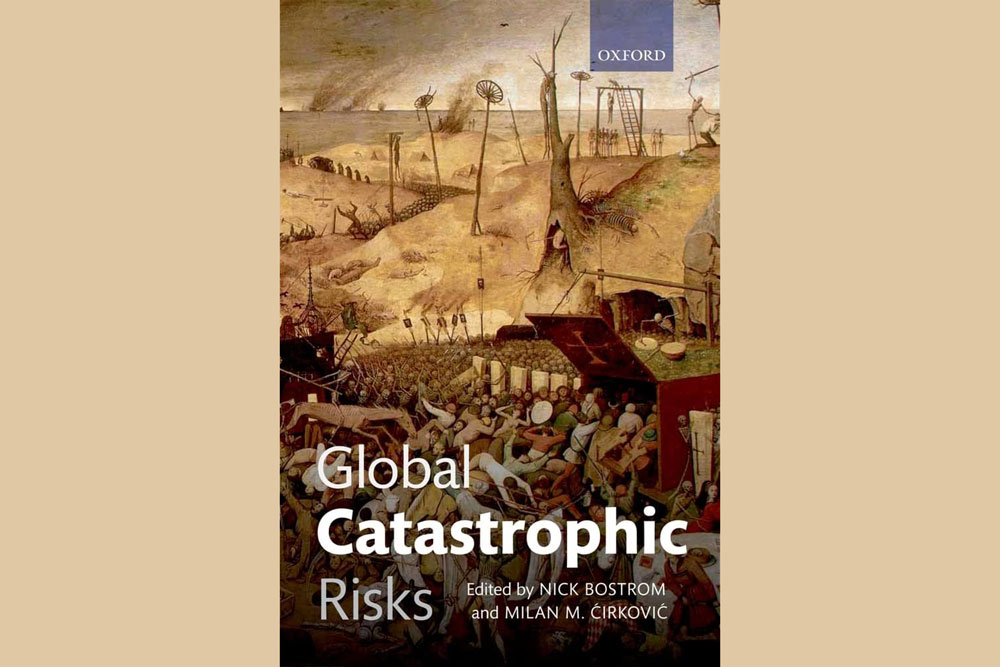
Global Catastrophic Risks

Global Catastrophic Risks

This book explores global catastrophic risks that threaten civilization and humanity’s continued existence, addressing key methodological, ethical and policy issues. Chapters by leading experts address such risks as astronomical and earth-based natural catastrophes, nuclear war, terrorism, biological weapons, totalitarianism, advanced nanotechnology, artificial intelligence, and social collapse.

Global Catastrophic Risks Read More »

Resilience, Adaptability and Transformability in Social-Ecological Systems

The authors argue that “the stability dynamics of all linked systems of humans and nature emerge from three complimentary attributes: resilience, adaptability, and transformability” (p. 1), then distinguish and clarify these core concepts. “Resilience is the capacity of a system to absorb disturbance and reorganize while undergoing change so as to still retain essentially the

Resilience, Adaptability and Transformability in Social-Ecological Systems Read More »

Scroll to Top