Think Tank (or University) Report

What is a Global Polycrisis? And how is it Different from a Systemic Risk?

This discussion paper proposes that “A global polycrisis occurs when crises in multiple systems become causally entangled in ways that significantly reduce humanity’s prospects. These interacting crises produce harms greater than the sum of those the crises would produce in isolation, were their host systems not so deeply intertwined” (p. 2). The authors then elaborate […]

What is a Global Polycrisis? And how is it Different from a Systemic Risk? Read More »

A Call for an International Research Program on the Risk of a Global Polycrisis

The authors propose that hitherto unrecognized, complex teleconnections and self-reinforcing feedbacks among global systems are accelerating, amplifying, and synchronizing crises. The ultimate result of such unrecognized processes could be a global polycrisis—a single, macro-crisis of interconnected, runaway failures of Earth’s vital natural and social systems that irreversibly degrades humanity’s prospects. The authors therefore call for

A Call for an International Research Program on the Risk of a Global Polycrisis Read More »

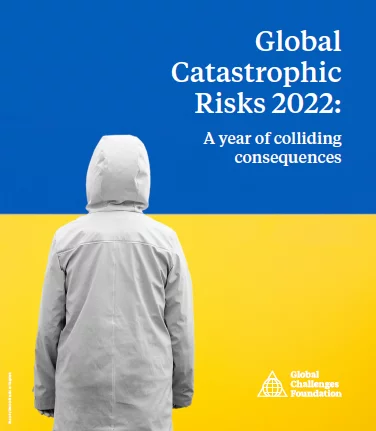
Global Catastrophic Risks 2022: A Year of Colliding Consequences

The report provides an overview of several catastrophic risks that are potentially global in scope: weapons of mass destruction, pandemics, artificial intelligence, asteroids, climate change, super-volcanic eruptions, ecological collapse, population growth, and climate tipping points. For each risk, it explores the key factors that affect the risk levels and the extant governance frameworks that address

Global Catastrophic Risks 2022: A Year of Colliding Consequences Read More »

Deep Adaptation: A Map for Navigating Climate Tragedy (revised 2nd edition)

Starting from the premise that society will collapse in the near-term, Jem Bendell argues that rather than debating the inevitability of that collapse we should consider what to do when it happens. He proposes a “deep adaptation agenda” as a framework for community dialogue to face the challenges, including four themes: resilience, relinquishment, restoration, and

Deep Adaptation: A Map for Navigating Climate Tragedy (revised 2nd edition) Read More »

Places to Intervene in a System

Complex systems have leverage points, critical places where a change can profoundly alter system behaviors. Donella Meadows explores twelve leverage points in complex systems using real-world examples. “Leverage points are not easily accessible, even if we know where they are and which direction to push on them…you have to work at it, whether that means

Places to Intervene in a System Read More »

Scroll to Top