Human Cognition and the Anthropocene
This report examines how Anthropocene conditions shape the brain and mind, while human cognition and social processes, in turn, drive and sustain global change.
Human Cognition and the Anthropocene Read More »
This report examines how Anthropocene conditions shape the brain and mind, while human cognition and social processes, in turn, drive and sustain global change.
Human Cognition and the Anthropocene Read More »
The report AI for a Planet Under Pressure examines the potential of artificial intelligence (AI) to address the contemporary polycrisis by supporting research and decision-making across interconnected sustainability challenges. Synthesizing expert assessments and AI-supported analysis of over 8,500 publications, it evaluates AI’s role across eight critical domains: systemic shocks, Earth system dynamics, ocean stewardship, freshwater
AI for a Planet Under Pressure Read More »
This report presents a systematic effort to theorize what the authors call “derailment risk,” a vicious cycle in which escalating climate impacts and the disruptive consequences of green transitions undermine climate action. Drawing on twenty global workshops and hundreds of expert contributions, the project mapped how worsening disasters, resource diversion, and political backlash can derail
This report introduces the Cascade Institute’s Stress-Trigger-Crisis model, a systemic framework that distinguishes between slow-moving stresses that erode the resilience of global systems and fast-moving trigger events that precipitate crises. It identifies 14 global systemic stresses that affect nine vital systems: climate, ecology, food, energy, economy, infrastructure, health, social order and governance, and world order.
Global Systemic Stresses: Understanding the Drivers of Polycrisis Read More »
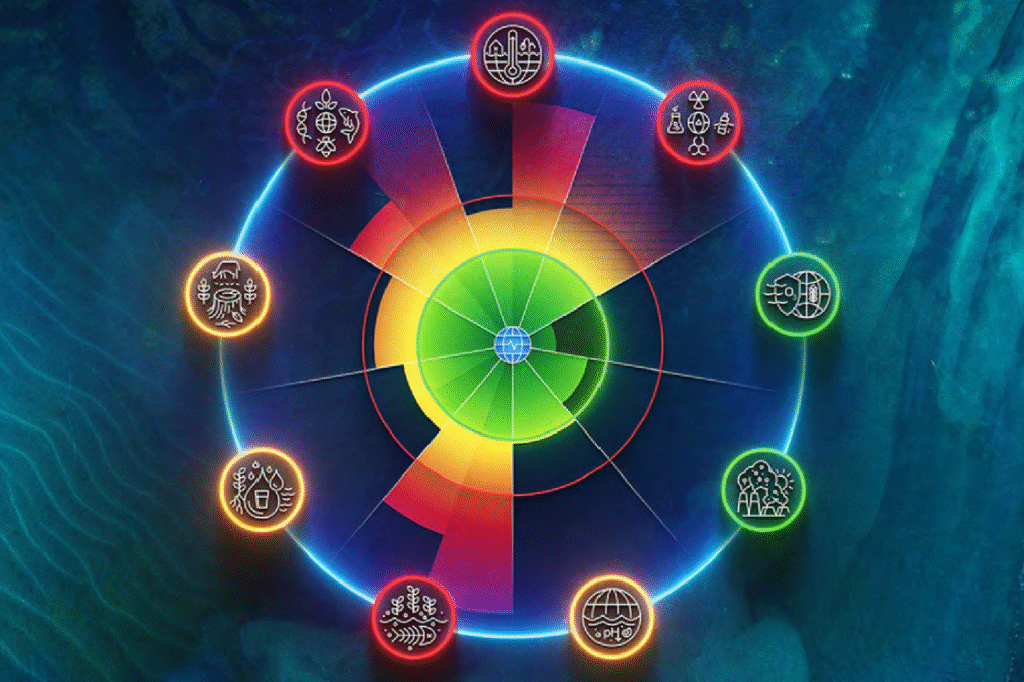
The report presents a global risk management framework to address climate-related challenges and introduces the Planetary Solvency risk dashboard, providing policymakers with actionable insights to guide human activity within the planet’s finite resources.
Planetary Solvency – finding our balance with nature Read More »
The author examines the concept of polycrisis, exploring how multiple crises in the Middle East and North Africa (MENA), including the “energy dilemma,” water scarcity, climate-induced migration, and persistent conflicts converge and exacerbate each other.
Navigating the Polycrisis: MENA at a Crucial Crossroads Read More »
The authors explore the significant impact of disinformation on elections, emphasizing its potential to undermine democratic processes. Through case studies from Hungary, the United States, and the United Kingdom, they analyze how disinformation spreads, the conditions that facilitate its dissemination, and its detrimental effects on the health of democracies. The report delves into the historical
A Dangerous Confluence: The Intertwined Crises of Disinformation and Democracies Read More »
This study explores leadership capabilities needed to effectively navigate the unprecedented challenges of polycrisis contexts.
Leadership in Polycrisis: Essential Capabilities for Navigating Global Challenges Read More »
The November 2024 federal election in the United States could mark an abrupt inflection point not only in the evolution of the American polity but also in the direction of global society. In this report, the Cascade Institute’s Polycrisis research team examines possible global systemic impacts of a second Trump presidency and maps the ways
Impact 2024: How Donald Trump’s Reelection Could Amplify Global Inter-systemic Risk Read More »
The 2024 Planetary Health Check report reveals that six of the nine Planetary Boundary processes have exceeded safe levels, with all six showing increasing pressure across control variables, indicating further boundary transgressions in the near future.
Planetary Health Check Report 2024 Read More »